
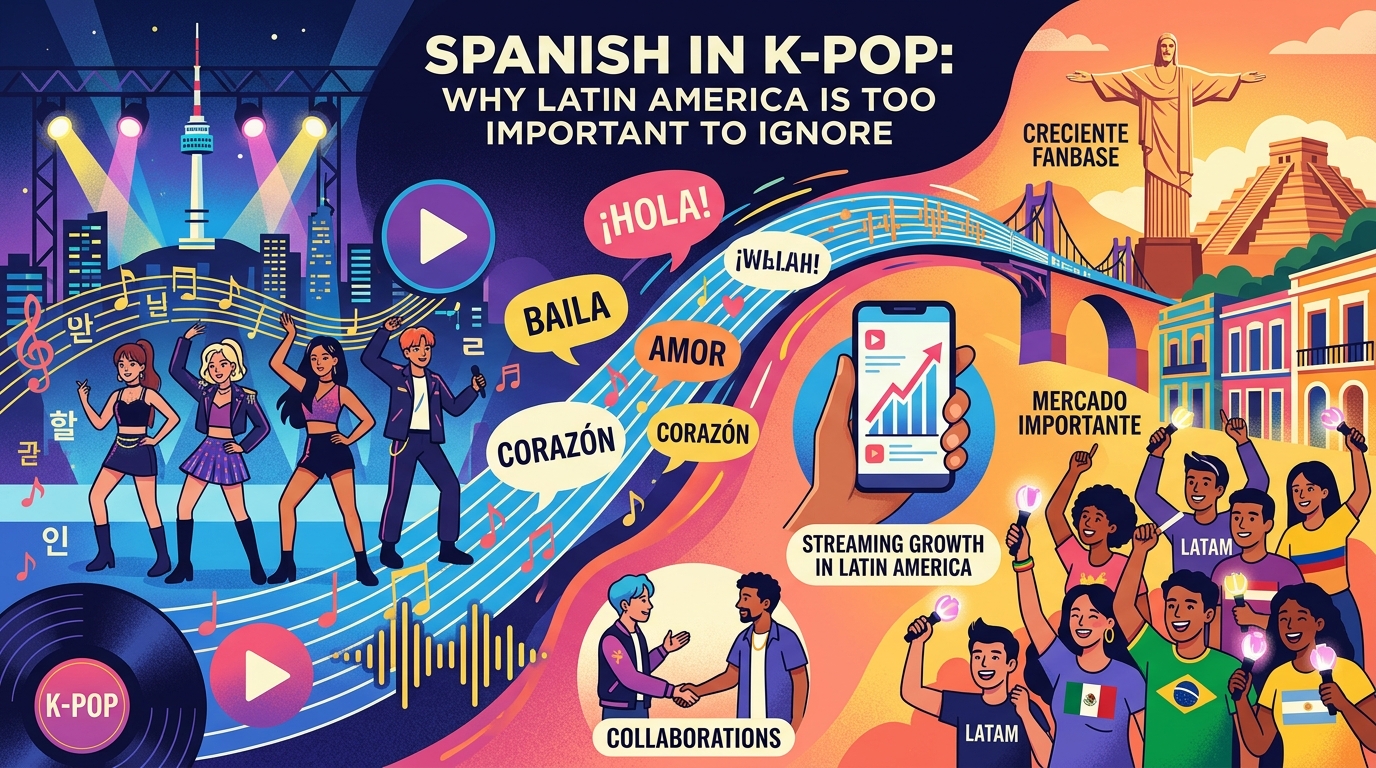
Latin America Is Becoming Too Important to Ignore
K-Pop Is Speaking More Than One Global Language
If you have been listening closely to recent K-pop releases, you may have noticed something new: more Spanish. It is showing up in hooks, ad-libs and full lyric phrases across songs by groups like Le Sserafim, Aespa and Ateez. This is not random styling. It reflects a bigger shift in the K-pop industry’s global strategy, especially as entertainment companies deepen their focus on Latin America.
최근 K-팝 신곡들을 자세히 들어보셨다면 한 가지 변화가 느껴지셨을 수 있습니다. 바로 스페인어가 더 자주 등장한다는 점입니다. 르세라핌, 에스파, 에이티즈 같은 그룹들의 곡에서 후렴구나 애드리브, 전체 가사 구절 속에 스페인어가 자연스럽게 섞여 들어가고 있습니다. 이는 단순한 장식이 아닙니다. 엔터테인먼트 업계가 라틴아메리카 시장에 더 깊이 집중하기 시작하면서 나타난 큰 전략 변화의 일부라고 볼 수 있습니다.

Latin America Is No Longer a Side Market
For years, K-pop focused heavily on major overseas markets like Japan, China and Southeast Asia. But competition in those regions has become more intense, and growth is no longer as easy as it once was. At the same time, Latin America has continued to show strong and passionate demand for K-pop, even with less promotional attention than other regions. That makes it one of the most attractive growth markets right now.
오랫동안 K-팝은 일본, 중국, 동남아 같은 주요 해외 시장에 집중해 왔습니다. 하지만 이 지역들은 경쟁이 훨씬 치열해졌고, 예전처럼 쉽게 성장하기 어려운 구조가 되었습니다. 반면 라틴아메리카는 다른 지역에 비해 상대적으로 적은 프로모션을 받아왔음에도 불구하고 K-팝에 대한 강한 열정과 수요를 꾸준히 보여주고 있습니다. 그래서 지금 가장 매력적인 성장 시장 중 하나로 떠오르고 있는 것입니다.
Spanish Lyrics Are a Signal, Not a Decoration
Songs like “Boompala,” “Lemonade” and “Bad” show that Spanish is becoming more than a cool sound effect. According to critic “Lim Hee-yun,” it now represents a direct way to connect with fans in one of the industry’s fastest-growing regions. Fans in Latin America have always embraced Korean-language songs, but adding Spanish creates a different emotional bridge. It tells listeners that the industry is not just exporting content — it is trying to listen back.
“Boompala”, “Lemonade”, “Bad” 같은 곡들은 스페인어가 단순히 멋있게 들리는 요소를 넘어서고 있음을 보여줍니다. 평론가 “임희윤”의 설명처럼, 이제 스페인어는 업계에서 가장 빠르게 성장하는 지역 중 하나의 팬들과 직접 연결되기 위한 하나의 언어가 되고 있습니다. 라틴아메리카 팬들은 원래부터 한국어 노래를 적극적으로 받아들여 왔지만, 여기에 스페인어가 더해지면 전혀 다른 정서적 다리가 생깁니다. 이는 K-팝 산업이 단지 콘텐츠를 수출하는 것이 아니라, 그 시장의 목소리에 응답하려 하고 있다는 신호이기도 합니다.

It’s Not Just the Lyrics — It’s the Whole Strategy
The language shift is part of something much bigger. Agencies are launching localized festivals, performing in Spanish at local events and even building long-term regional operations. Nmixx, Stray Kids and Ateez are not only visiting Latin America — they are becoming more present inside it. Hybe has even expanded through Hybe Latin America and debuted a Latin American boy group. In other words, Spanish in lyrics is just the most visible layer of a deeper industry move.
이 언어 변화는 사실 훨씬 더 큰 전략의 일부입니다. 기획사들은 현지 맞춤형 페스티벌을 만들고, 현지 행사에서 스페인어로 무대를 소화하며, 장기적인 지역 운영 기반까지 구축하고 있습니다. Nmixx, Stray Kids, Ateez는 단순히 라틴아메리카를 방문하는 것을 넘어, 그 지역 안에 더 깊이 존재감을 만들고 있습니다. Hybe는 Hybe Latin America를 통해 현지 보이그룹까지 데뷔시켰습니다. 다시 말해 가사 속 스페인어는 더 큰 산업 전략 중 가장 눈에 띄는 표면일 뿐입니다.
A New Phase of Global K-Pop
K-pop is entering a phase where global success means more than simply being streamed everywhere. It now means speaking to fans in ways that feel more local, more emotional and more intentional. Like in “Babel,” language can divide people, but it can also create surprising forms of connection. The growing presence of Spanish in K-pop shows that the industry is trying to do exactly that — build a bigger world by sounding a little closer to home.
K-팝은 이제 단순히 전 세계 어디서나 스트리밍되는 것만으로 글로벌 성공을 정의할 수 없는 단계에 들어서고 있습니다. 앞으로의 성공은 각 지역 팬들에게 더 현지적이고, 더 감정적이며, 더 의도적으로 다가가는 방식까지 포함하게 될 것입니다. “Babel”처럼 언어는 사람들을 갈라놓을 수도 있지만, 뜻밖의 연결을 만들어낼 수도 있습니다. K-팝에서 스페인어의 존재감이 커지고 있다는 사실은 업계가 바로 그런 연결을 시도하고 있음을 보여줍니다. 더 큰 세계를 만들기 위해, 조금 더 가까운 언어로 다가가고 있는 것입니다.