
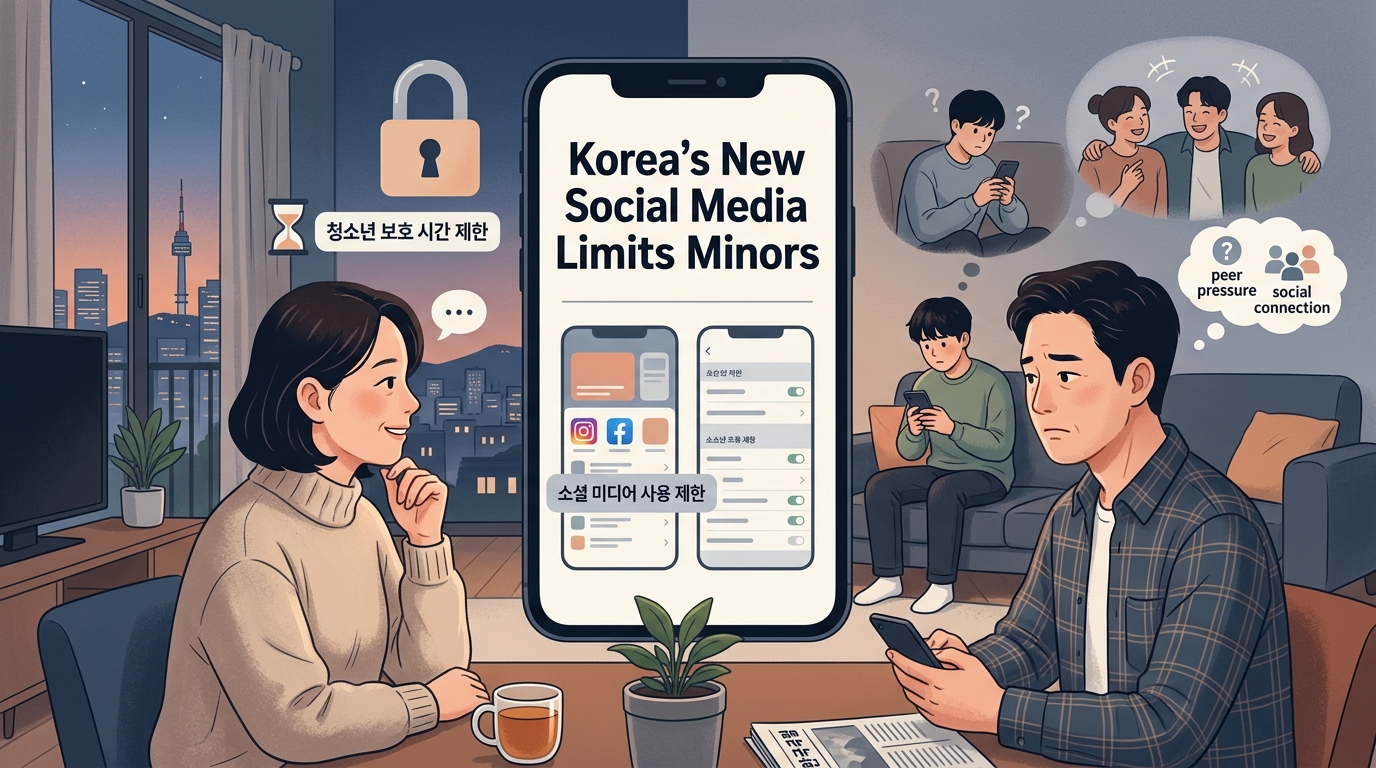
Why Parents Support It but Still Feel Uneasy
A Growing Problem Parents Can No Longer Ignore
In Korea, more parents are saying the same thing: children are spending too much time on social media, and families are struggling to control it alone. That is why the government’s new proposal to limit minors’ use of social platforms is getting serious attention. The Korea Communications Commission is considering blocking children under 14 from creating social media accounts and restricting addictive features for users under 19. For many parents, this feels like overdue help.
한국에서는 점점 더 많은 부모들이 같은 고민을 하고 있습니다. 아이들이 소셜미디어에 너무 많은 시간을 쓰고 있고, 가정만의 힘으로는 이를 통제하기가 어렵다는 것입니다. 그래서 정부가 미성년자의 소셜미디어 이용을 제한하는 새 방안을 검토하고 있다는 소식이 큰 관심을 받고 있습니다. 방송통신위원회는 14세 미만 아동의 계정 생성 제한과 19세 미만 청소년을 대상으로 한 중독성 기능 제한을 검토 중입니다. 많은 부모들에게 이는 늦었지만 꼭 필요한 도움처럼 느껴지고 있습니다.

Why Parents Are Welcoming the Plan
Parents describe a daily pattern that feels all too familiar: Shorts, Reels and endless scrolling during every spare moment. What begins as ten minutes quickly becomes an hour. As “Hong Eun-hee” explained, even homework and bedtime are constantly interrupted by phones, and attempts to intervene often end in arguments. For families already worried about sleep loss, reduced concentration, cyberbullying and harmful content, government action feels more realistic than leaving everything to household rules.
부모들이 이 계획을 반기는 이유는 일상에서 너무 익숙해진 장면들 때문입니다. 숏폼 영상과 릴스를 틈날 때마다 보고, 10분만 본다고 해놓고 어느새 한 시간이 지나버리는 상황이 반복됩니다. “홍은희”의 말처럼 숙제 중에도 휴대전화를 계속 확인하고, 잠들기 전까지 손에서 놓지 않으려 하며, 이를 말리는 과정은 자주 다툼으로 이어집니다. 수면 부족과 집중력 저하, 사이버불링, 유해 콘텐츠 노출을 걱정하는 가정에게 정부 차원의 조치는 단순한 가정 규칙보다 훨씬 현실적인 대안처럼 보입니다.
The Real Question: Can It Actually Work?
Even parents who support the idea are not fully confident it will be effective. Some worry that children will simply use their parents’ accounts or move to slightly different apps with similar functions. Others ask a more basic question: what exactly counts as social media? As “Park Sun-kyung” pointed out, services can easily be renamed or redesigned, making regulation messy. In digital culture, the boundary between messaging, content and social networking is no longer clear.
하지만 이 제도를 지지하는 부모들조차도 실제로 얼마나 효과가 있을지에 대해서는 확신하지 못하고 있습니다. 어떤 부모들은 아이들이 부모 계정을 사용하거나, 비슷한 기능을 가진 다른 앱으로 이동할 것이라고 우려합니다. 또 다른 부모들은 더 근본적인 질문을 던집니다. 도대체 무엇을 소셜미디어로 볼 것인가 하는 점입니다. “박선경”이 지적했듯이 서비스는 이름만 바꾸거나 구조를 조금 수정해도 쉽게 규제를 피해갈 수 있습니다. 오늘날 디지털 문화에서는 메신저와 콘텐츠 플랫폼, 소셜 네트워킹의 경계가 이미 매우 흐려졌습니다.

Social Media Is No Longer the Only Concern
What makes the issue even harder is that social media is no longer the only digital pull on children. Some parents say AI character chat apps may be even more immersive because they create personalized and emotionally sticky virtual relationships. That means regulation focused only on Instagram or YouTube may already be too narrow. The problem is expanding faster than the categories used to describe it.
문제를 더 복잡하게 만드는 것은 이제 소셜미디어만이 아이들을 끌어당기는 디지털 공간이 아니라는 사실입니다. 일부 부모들은 AI 캐릭터 채팅 앱이 오히려 더 위험할 수 있다고 말합니다. 개인 맞춤형 대화와 정서적으로 몰입되는 가상 관계를 만들기 때문입니다. 즉, 인스타그램이나 유튜브만을 겨냥한 규제는 이미 너무 좁은 접근일 수 있습니다. 문제는 우리가 그것을 설명하는 개념보다 더 빠르게 확장되고 있습니다.
More Than Restriction, Korea Needs a Digital Parenting Strategy
Korea’s debate over minors and social media is really about something bigger: how to raise children in an age of endless digital temptation. Like in “Brave New World,” the challenge is not just banning access, but understanding how technology shapes desire, habit and attention. Regulation may help, but it cannot stand alone. Parents, schools, companies and the government will all need to build a broader strategy if they want to protect children without simply pushing the problem somewhere else.
한국에서 벌어지는 미성년자와 소셜미디어에 대한 논쟁은 결국 더 큰 문제와 연결되어 있습니다. 끝없이 유혹하는 디지털 환경 속에서 아이들을 어떻게 키울 것인가 하는 질문입니다. “Brave New World”처럼 문제는 단지 접근을 막는 데 있지 않고, 기술이 욕망과 습관, 집중력을 어떻게 바꾸는지를 이해하는 데 있습니다. 규제는 분명 도움이 될 수 있지만, 그것만으로는 충분하지 않습니다. 부모와 학교, 기업, 정부 모두가 함께 더 넓은 대응 전략을 만들어야만 아이들을 보호하면서도 문제를 다른 곳으로 밀어내는 데 그치지 않을 수 있습니다.