
Why Mongolia’s Capital Is Starting to Look Like a Korean Food and Retail Hub
A New Nickname Says a Lot
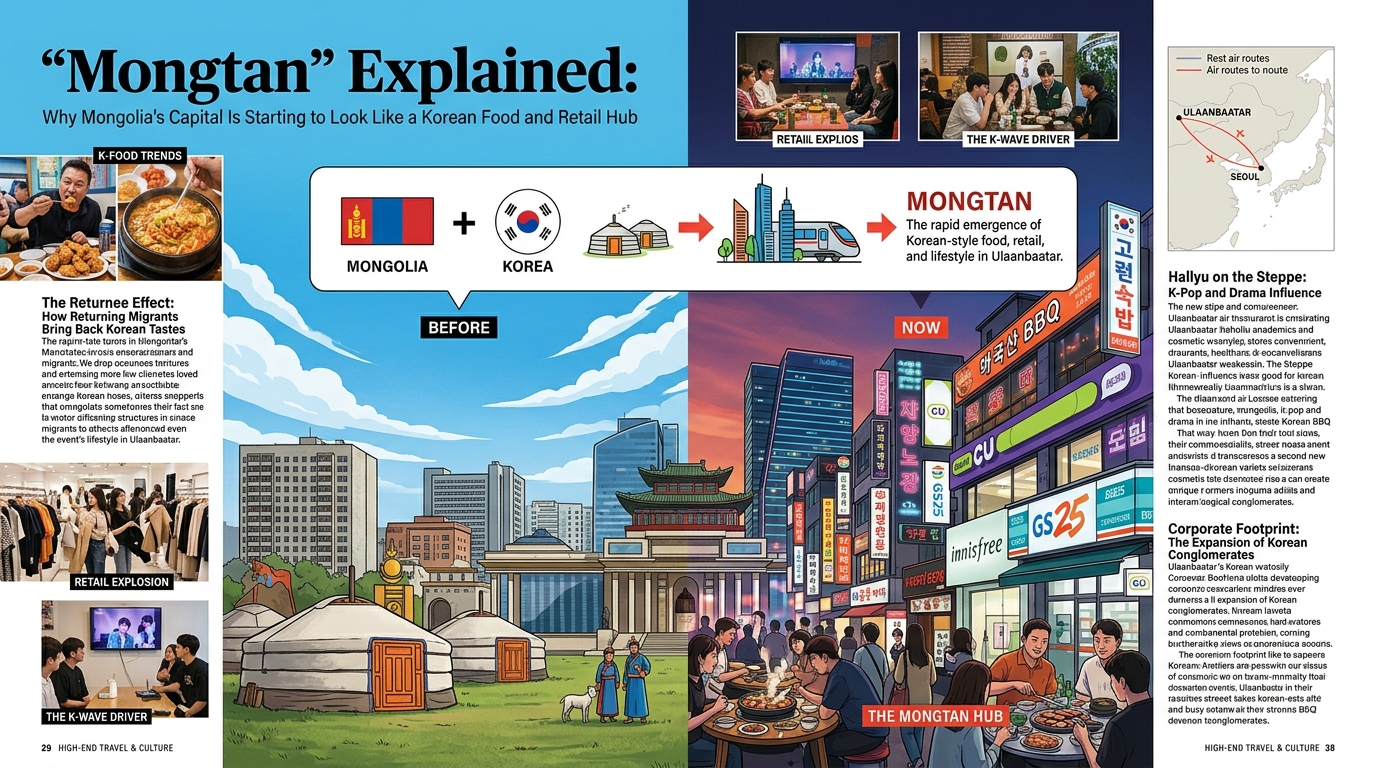
Ulaanbaatar now has a Korean nickname: “Mongtan.” It combines Mongolia with Dongtan, a large planned city south of Seoul, and the name alone tells you how strong Korea’s influence has become in the Mongolian capital. In many parts of the city, Korean convenience stores, bakeries, burger chains and coffee brands are so common that the streets can feel surprisingly familiar to anyone from Korea.
울란바토르에는 이제 한국식 별명이 생겼습니다. 바로 “몽탄”입니다. 몽골과 서울 남쪽의 대규모 신도시 동탄을 합친 이름인데, 이 별명만으로도 한국의 영향력이 몽골 수도에서 얼마나 강해졌는지 짐작할 수 있습니다. 실제로 도시 곳곳에서는 한국 편의점과 베이커리, 버거 체인, 커피 브랜드를 쉽게 볼 수 있어 한국인에게는 놀랄 만큼 익숙한 거리 풍경처럼 느껴질 수 있습니다.

Korean Convenience Stores Are Everywhere
The clearest sign of this transformation is convenience retail. CU recently opened its 600th store in Mongolia, becoming the first Korean retailer to hit that scale in a single overseas market. GS25 has also built a major network, and No Brand has opened its largest overseas location there. This is not just about selling snacks. Korean convenience stores are filling real infrastructure gaps in Mongolia, offering rest stops, reliable food access and familiar urban services in a city that is still rapidly growing.
이 변화의 가장 눈에 띄는 지점은 바로 편의점 유통망입니다. CU는 최근 몽골 600호점을 열며 단일 해외 시장에서 이 정도 규모를 달성한 첫 한국 유통 브랜드가 되었습니다. GS25도 대규모 네트워크를 구축했고, 노브랜드 역시 현지 최대 규모의 해외 매장을 열었습니다. 이것은 단순히 간식을 파는 사업이 아닙니다. 한국 편의점들은 몽골의 사회 인프라 공백을 메우며 휴식 공간, 안정적인 식품 공급, 익숙한 도시형 서비스를 제공하고 있습니다.
Why K-Food Works So Well There
One major reason K-food is thriving in Ulaanbaatar is demographics. The city’s median age is just around 25, which means a young consumer base that is highly open to trends, fast-moving brands and Korean pop culture. Officials and industry insiders now see Mongolia not only as an export destination, but as a place to build long-term consumer habits. That is why Korean brands are no longer just testing the market — they are laying foundations.
K-푸드가 울란바토르에서 잘 통하는 가장 큰 이유 중 하나는 인구 구조입니다. 이 도시의 중위연령은 약 25세 수준으로 매우 젊기 때문에, 트렌드에 민감하고 빠르게 움직이는 브랜드와 한국 대중문화에 대한 수용성이 높습니다. 이제 정부와 업계는 몽골을 단순한 수출처가 아니라 장기적인 소비 습관을 형성할 수 있는 시장으로 보고 있습니다. 그래서 한국 브랜드들은 더 이상 단순한 시험 진출이 아니라 본격적인 기반 구축에 나서고 있습니다.

Beer, Bread and Coffee Followed Fast
Food and beverage brands beyond convenience stores are riding the same wave. Cass became Mongolia’s biggest imported beer success story, and other Korean beer brands are expanding fast. Bakery chains like Tous Les Jours and Paris Baguette are extending their footprint, while Lotteria, Mom’s Touch and Mega MGC Coffee are growing store by store. What is striking is not just the number of brands, but the way they are becoming part of daily life rather than occasional foreign treats.
편의점 외의 식음료 브랜드들도 같은 흐름을 타고 있습니다. Cass는 몽골에서 가장 성공한 수입 맥주 사례가 되었고, 다른 한국 맥주 브랜드들도 빠르게 시장을 넓히고 있습니다. Tous Les Jours와 Paris Baguette 같은 베이커리 체인, Lotteria와 Mom’s Touch, Mega MGC Coffee 같은 외식 브랜드도 매장 수를 늘리고 있습니다. 주목할 점은 브랜드 수 자체보다, 이들이 특별한 외국 음식이 아니라 현지의 일상 소비 안으로 들어가고 있다는 사실입니다.
More Than Export, This Is Cultural Embedding
What makes “Mongtan” interesting is that it shows how K-culture now travels through ordinary consumption, not just entertainment. People are not only watching Korean dramas or listening to K-pop. They are drinking Korean beer, stopping at Korean convenience stores and building daily habits around Korean brands. Like in “The Great Gatsby,” influence becomes strongest when it stops looking flashy and starts feeling normal. That may be exactly what is happening in Ulaanbaatar.
“몽탄”이라는 현상이 흥미로운 이유는 K-컬처가 이제 더 이상 콘텐츠만으로 이동하지 않고, 일상 소비를 통해 스며들고 있음을 보여주기 때문입니다. 사람들은 한국 드라마를 보고 K-pop을 듣는 데서 그치지 않고, 한국 맥주를 마시고, 한국 편의점에 들르고, 한국 브랜드를 중심으로 생활 습관을 만들어가고 있습니다. “The Great Gatsby”처럼 영향력은 화려하게 보일 때보다 자연스럽고 당연하게 느껴질 때 더 강해집니다. 지금 울란바토르에서 바로 그런 일이 벌어지고 있는지도 모릅니다.