
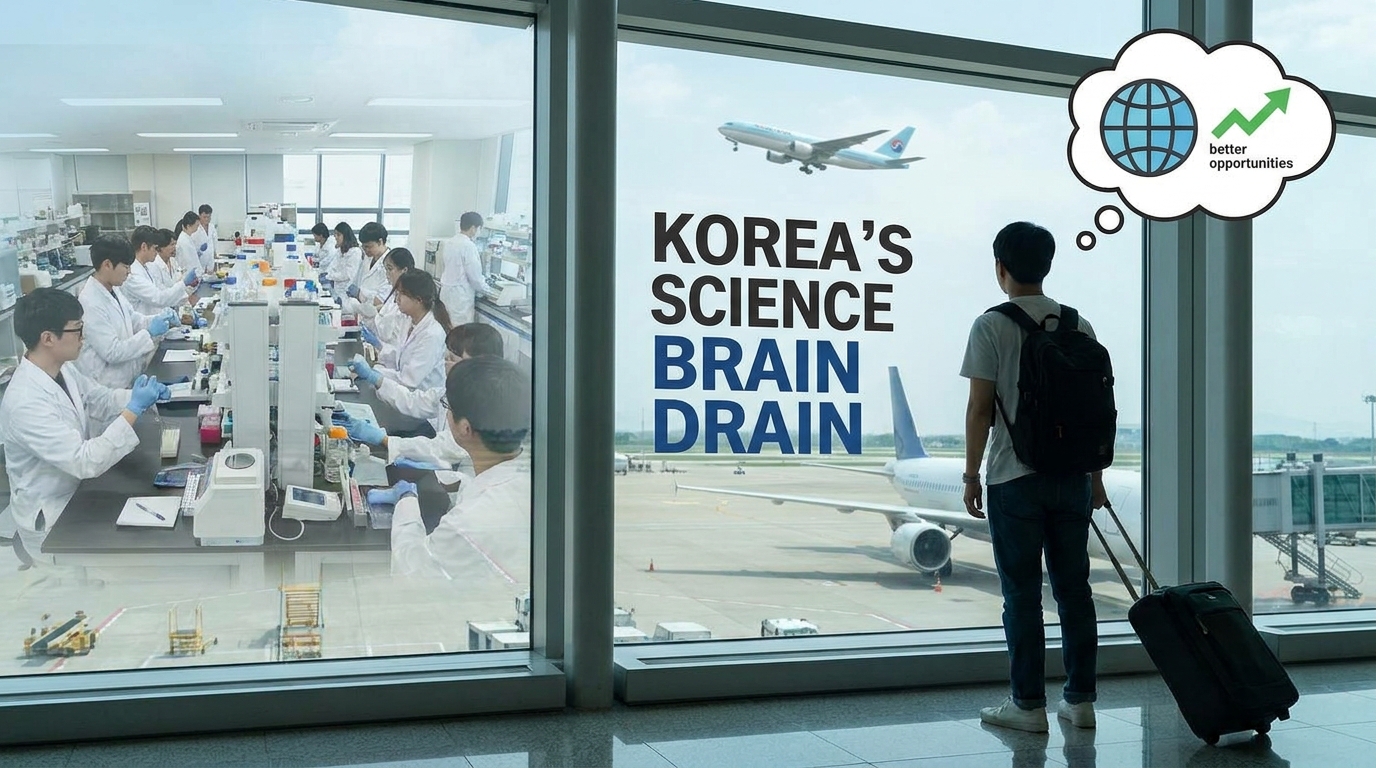
Why Young Researchers Still Want to Leave
Record Funding, But Growing Doubt
On paper, Korea looks deeply committed to science. Government R&D spending hit a record 35.5 trillion won this year, and total national research spending, including private investment, is massive by global standards. But money on paper is not the same as confidence on the ground. More and more young Korean researchers are still thinking about leaving the country, and that gap says a lot about what funding alone cannot fix.
겉으로 보면 한국은 과학기술에 매우 강하게 투자하는 나라처럼 보입니다. 올해 정부 연구개발 예산은 35조 5천억 원으로 역대 최대를 기록했고, 민간 투자까지 포함한 전체 연구개발 규모도 국제적으로 매우 높은 수준입니다. 그러나 숫자로 보이는 투자와 현장에서 느끼는 확신은 다릅니다. 여전히 많은 젊은 연구자들이 해외 이탈을 고민하고 있다는 사실은, 예산만으로 해결되지 않는 문제가 무엇인지 잘 보여줍니다.

Why Researchers Are Looking Abroad
The biggest reasons are painfully practical. Low pay, unstable career paths, weak autonomy in research and too much paperwork are pushing talent away. “Choi Jae-hyung,” a doctoral student at MIT, compared Korea and the United States bluntly: there are more opportunities abroad, and the compensation is better. For many young scientists, the question is no longer whether they love research. It is whether research in Korea can support a real life.
가장 큰 이유는 매우 현실적입니다. 낮은 보수, 불안정한 진로, 제한된 연구 자율성, 과도한 행정 업무가 인재를 밖으로 밀어내고 있습니다. MIT 박사과정생인 “최재형”은 한국과 미국을 비교하며 해외에는 기회가 더 많고 보상도 더 낫다고 말했습니다. 많은 젊은 과학기술 인재들에게 중요한 질문은 이제 연구를 사랑하느냐가 아닙니다. 한국에서 연구를 하며 실제 삶을 꾸릴 수 있느냐는 점입니다.
The Salary Gap Feels Too Large
The pay difference is hard to ignore. Public research institute salaries in Korea have risen more slowly than inflation, and even doctoral-level researchers often begin with incomes that feel underwhelming compared with major corporations or overseas labs. “Jung Min-seop” recalled receiving his first monthly paycheck after earning a doctorate and wondering whether he should work nights as a designated driver. When Silicon Valley offers several times more for similar talent, the emotional weight of staying becomes much heavier.
급여 격차는 쉽게 무시할 수 없는 수준입니다. 한국의 공공 연구기관 임금은 물가 상승률에도 미치지 못하는 수준으로 오른 경우가 많고, 박사급 연구자조차 체감상 매우 낮은 출발점을 경험하고 있습니다. “정민섭”은 박사 학위 취득 후 처음 받은 월급을 떠올리며 대리운전까지 고민했었다고 말했습니다. 반면 실리콘밸리에서는 비슷한 인재에게 몇 배의 보상이 제시되기 때문에, 한국에 남는 선택은 감정적으로도 훨씬 무거운 결정이 됩니다.

The System Drains Energy Too
It is not only about money. Many researchers say Korea’s system itself exhausts them. Government priorities shift with each administration, forcing labs to reshape their research themes to match political trends. Administrative burdens also eat into actual science. As “Lee,” a doctoral student in the U.S., explained, Korean labs often push waste sorting, receipts and procurement paperwork onto graduate students, while overseas labs usually have dedicated staff. That difference changes the daily reality of research.
문제는 돈만이 아닙니다. 많은 연구자들은 한국의 시스템 자체가 사람을 지치게 만든다고 말합니다. 정권이 바뀔 때마다 정부의 우선순위가 달라지면서 연구실은 정치적 흐름에 맞춰 주제를 다시 포장해야 하는 경우가 많습니다. 행정 부담도 실제 연구 시간을 갉아먹습니다. 미국에서 박사과정을 밟고 있는 “이” 씨의 설명처럼, 한국의 연구실은 폐기물 정리나 영수증 관리, 구매 서류 작업 등을 대학원생에게 떠넘기는 경우가 많지만 해외 연구실은 이를 전담 인력이 맡는 경우가 많습니다. 이런 차이는 연구의 일상 자체를 바꿉니다.
What Korea Must Prove to Its Scientists
At the core of this issue is one brutal question from young researchers: if I devote myself to science, what kind of future can I actually build? As “Cho Yong-chul” admitted, even educators struggle to answer that clearly. Like in “Frankenstein,” the real danger is not technology itself but what happens when creators are neglected. Korea does not only need bigger research budgets. It needs to prove that a scientific career can offer stability, dignity and a future worth choosing.
이 문제의 중심에는 젊은 연구자들이 던지는 매우 냉정한 질문이 있습니다. 연구에 헌신하면 나는 어떤 미래를 실제로 만들 수 있는가 하는 점입니다. “조용철”이 인정했듯, 교육자들조차 이 질문에 선뜻 답하기 어려운 현실입니다. “Frankenstein”처럼 진짜 위험은 기술 그 자체가 아니라 그것을 만드는 사람들이 방치될 때 생깁니다. 한국에 필요한 것은 더 큰 연구비만이 아닙니다. 과학자의 삶이 안정과 존중, 그리고 선택할 만한 미래를 줄 수 있다는 사실을 증명하는 일입니다.