
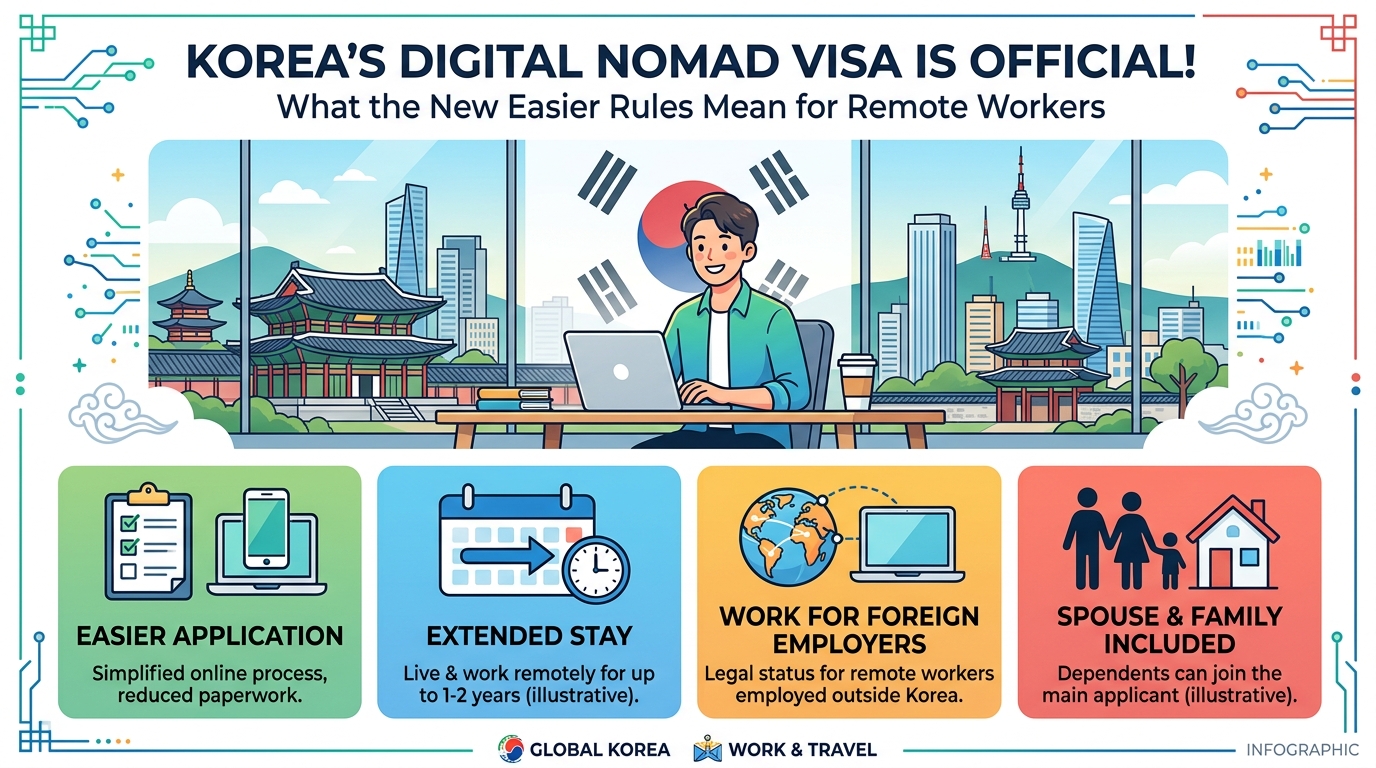
What the New Easier Rules Mean
Korea Is Now Open to Digital Nomads
South Korea has officially launched its digital nomad visa, and this is big news for remote workers around the world. The new F-1-D visa, often called the workation visa, allows foreigners employed by overseas companies to live in Korea while continuing to work remotely. Unlike a traditional work visa, you do not need to be hired by a Korean company. That makes Korea a much more realistic option for freelancers, remote employees and location-flexible professionals who have been eyeing Seoul, Busan or smaller Korean cities.
한국이 공식적으로 디지털 노마드 비자를 도입했습니다. 이는 전 세계 원격 근무자들에게 매우 큰 뉴스입니다. 새롭게 시행된 F-1-D 비자, 이른바 워케이션 비자는 해외 기업에 소속된 외국인이 한국에 체류하면서 원격으로 계속 일할 수 있도록 허용합니다. 기존 취업비자처럼 한국 회사에 고용될 필요가 없기 때문에, 서울이나 부산, 혹은 한국의 중소도시에서 살아보고 싶었던 프리랜서와 원격 근무자, 그리고 장소에 구애받지 않는 전문직들에게 훨씬 현실적인 선택지가 되었습니다.

The Rules Just Got More Flexible
What makes this launch even more interesting is that the eligibility rules are now easier than they were during the pilot program. During the test phase, applicants generally needed to earn at least twice Korea’s per capita gross national income. Now the government has lowered that threshold for certain groups. Younger applicants and those planning to live outside the Greater Seoul area or in population-declining regions can qualify with much lower income requirements.
이번 제도가 더욱 주목받는 이유는 시범 운영 때보다 자격 요건이 완화되었기 때문입니다. 파일럿 프로그램에서는 보통 한국 1인당 국민총소득의 두 배 이상을 벌어야 신청이 가능했습니다. 하지만 이제는 특정 조건에 따라 기준이 훨씬 낮아졌습니다. 젊은 신청자나 수도권 밖, 혹은 인구 감소 지역에 거주하려는 사람들은 훨씬 낮은 소득 기준으로도 자격을 갖출 수 있게 되었습니다.
Why Location Now Matters
One of the smartest parts of the new policy is that it encourages people to live beyond Seoul. For example, applicants aged 18 to 34 who choose to reside outside Seoul, Incheon and Gyeonggi can apply if they meet just the previous year’s per capita GNI, not double that amount. This shows that Korea is not only trying to attract global talent, but also hoping that digital nomads will help revitalize local economies and regional communities.
이번 정책에서 특히 눈에 띄는 점은 수도권 밖 거주를 유도하고 있다는 부분입니다. 예를 들어 18세에서 34세 사이의 신청자가 서울, 인천, 경기 이외 지역에 거주할 경우, 전년도 1인당 GNI 수준만 충족해도 신청이 가능합니다. 두 배의 소득을 요구하지 않는 것입니다. 이는 한국이 단지 글로벌 인재를 끌어들이는 데 그치지 않고, 디지털 노마드들이 지역 경제와 지방 공동체에도 활력을 줄 수 있기를 기대하고 있음을 보여줍니다.

Staying Longer Means Building Roots
Another major change is the maximum stay period. Under the pilot, people could stay up to two years. Now that has been extended to three. That extra year matters because it shifts the visa from a short experiment into something closer to a lifestyle option. As “Jung Sung-ho” explained, the bigger vision is not just temporary tourism but encouraging highly skilled people to experience Korea deeply and potentially settle more permanently.
또 하나 중요한 변화는 체류 기간입니다. 시범 운영 때는 최대 2년까지 머물 수 있었지만, 이제는 최대 3년으로 늘어났습니다. 이 1년의 차이는 상당히 큽니다. 단순한 체험형 체류가 아니라 하나의 라이프스타일 선택지로 무게가 이동하기 때문입니다. “정성호” 장관의 설명처럼, 정부의 더 큰 목표는 단기 체류 관광이 아니라 우수한 글로벌 인재들이 한국을 깊이 경험하고 장기적으로 정착까지 고려하게 만드는 데 있습니다.
Korea Wants More Than Visitors
In the end, this visa is about more than convenience. It reflects Korea’s attempt to compete for global creative and skilled talent in a world where work is becoming more borderless. Like in “On the Road,” the appeal is not only movement but the possibility of finding a new place to belong. With easier rules and longer stays, Korea is clearly signaling that it wants digital nomads not just to visit, but to imagine a future here.
결국 이 비자는 단순한 편의 제도를 넘어서는 의미를 가집니다. 국경을 넘는 일의 형태가 점점 더 일반화되는 시대에, 한국이 글로벌 창의 인재와 고숙련 인력을 유치하기 위해 본격적으로 경쟁에 나서고 있음을 보여주기 때문입니다. “On the Road”처럼 이 비자가 담고 있는 매력은 단순한 이동이 아니라 새로운 소속감을 발견할 가능성에 있습니다. 완화된 요건과 늘어난 체류 기간을 통해 한국은 디지털 노마드들에게 단지 방문이 아니라, 이곳에서의 미래까지 상상해 보라고 신호를 보내고 있는 셈입니다.