
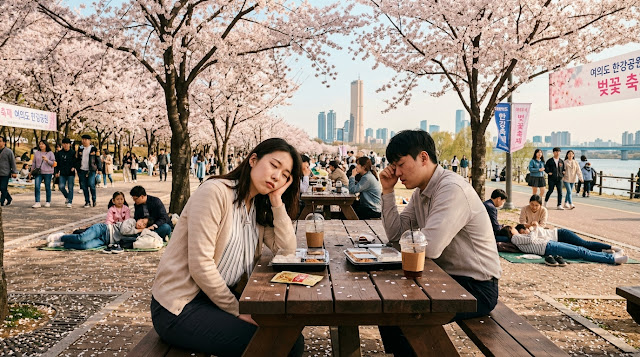
Why You Feel So Tired When the Weather Gets Warmer
You’re Not Imagining It — Spring Tiredness Is Real
If you’ve been fighting off yawns despite getting a full night’s sleep, you’re NOT alone! As the weather warms and sunlight stretches into the early evenings, many people start feeling unusually drowsy or sluggish. In Korea, this familiar seasonal fatigue is called “춘곤증” (chun-gon-jeung), which literally translates to “spring tiredness.” And honestly, it hits HARD every year around this time! 😴🌸
충분히 잤는데도 하품이 계속 나온다면, 혼자가 아닙니다! 날씨가 따뜻해지고 해가 길어지면서 많은 분들이 유난히 졸리거나 나른함을 느끼십니다. 한국에서는 이 익숙한 계절적 피로를 “춘곤증”이라고 부릅니다. 솔직히 매년 이맘때쯤 정말 심하게 찾아옵니다!
.jpeg "Spring Fatigue")
It’s Not a Disease — It’s Your Body Adjusting
Here’s the thing — doctors stress that spring fatigue ISN’T a disease but a physiological adjustment period. “Hwang Sun-wook”, a family medicine professor at Incheon St. Mary’s Hospital, explained: “It’s a temporary fatigue response caused by changes in biological rhythms and living environments.” Most people improve naturally once their routines stabilize. But the tiredness is definitely REAL — headaches, dizziness, digestive discomfort, and loss of appetite can all tag along! 🏥
춘곤증은 질병이 아니라 생리적 적응 기간입니다. 인천성모병원 가정의학과 교수 “황선욱”님은 “생체 리듬과 생활 환경 변화로 인한 일시적인 피로 반응”이라고 설명하셨습니다. 대부분 일상이 안정되면 자연스럽게 좋아집니다. 하지만 피로감은 분명히 실재하며 두통, 어지러움, 소화 불량, 식욕 감퇴 등이 동반될 수 있습니다!
How Sunlight Messes with Your Internal Clock
So WHY does this happen? Much of spring fatigue traces back to how sunlight affects your body’s internal clock. Humans operate on a roughly 24-hour cycle regulated by the suprachiasmatic nucleus in the brain. In spring, dawn comes earlier and dusk arrives later, so melatonin (the sleep hormone) is released at different times. This creates a temporary mismatch between your natural sleep-wake rhythm — leaving you feeling groggy during the day! ☀️⏰
왜 이런 일이 생길까요? 춘곤증의 많은 부분은 햇빛이 생체 시계에 미치는 영향과 관련이 있습니다. 인간은 뇌의 시교차상핵이 조절하는 약 24시간 주기로 작동합니다. 봄에는 해가 일찍 뜨고 늦게 지면서 수면 호르몬인 멜라토닌이 다른 시간에 분비됩니다. 이로 인해 자연스러운 수면-각성 리듬에 일시적인 불일치가 생겨 낮에 졸리게 됩니다!
.jpeg "Spring Fatigue")
When Should You Actually See a Doctor?
Not all fatigue should be brushed off as spring tiredness though! “Hwang” warned: “It isn’t advisable to dismiss all spring fatigue as chun-gon-jeung. If tiredness persists for three to four weeks despite rest, a medical evaluation is necessary.” Fatigue that lingers, worsens, or comes with symptoms like weight loss, night sweats, or fever may point to thyroid dysfunction, anemia, or sleep apnea. Take it seriously! ⚠️
모든 피로를 춘곤증으로 치부해서는 안 됩니다! “황”교수님은 “모든 봄철 피로를 춘곤증으로 무시하는 것은 바람직하지 않습니다. 충분히 쉬어도 3~4주간 피로가 지속되면 의료 평가가 필요합니다”라고 경고하셨습니다. 지속되거나 악화되는 피로, 체중 감소, 야간 발한, 발열 등의 증상이 동반되면 갑상선 기능 이상, 빈혈, 수면무호흡증의 신호일 수 있습니다!
How to Beat Spring Fatigue Naturally
Ready for solutions? Experts say restoring balance starts with a consistent sleep schedule — same bedtime and wake time EVERY day! Morning sunlight is especially helpful because it resets your circadian rhythm. Regular physical activity helps too, but DON’T rely on caffeine to power through — it disrupts nighttime sleep and makes fatigue WORSE the next day. For food, try iron-rich shellfish like oysters and mussels, or lean beef for heme iron and B vitamins! 🦪🥩
해결책을 알려드립니다! 전문가들은 균형 회복이 일관된 수면 스케줄에서 시작된다고 말합니다. 매일 같은 시간에 자고 일어나세요! 아침 햇빛은 생체 리듬을 재설정하는 데 특히 도움이 됩니다. 규칙적인 운동도 좋지만 카페인에 의존하지 마세요. 밤잠을 방해하고 다음 날 피로를 악화시킵니다. 음식으로는 굴, 홍합 같은 철분이 풍부한 조개류나 헴철과 비타민B가 풍부한 소고기를 드세요!
