
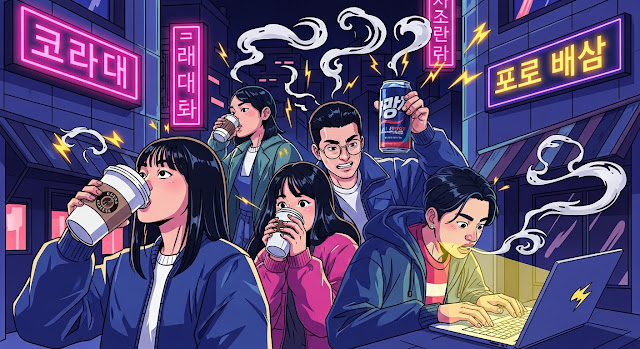
How Young Koreans Became Hooked on Caffeinated Drinks
Caffeine Is No Longer Just for Adults
Here’s something wild — caffeine used to be seen as a grown-up thing in Korea! “Yoo”, 52, remembers that when she was young, feeling tired meant drinking water or milk, or simply going to sleep. But times have TOTALLY changed. “Lee Jung-yeon”, a 26-year-old florist, started drinking “Let’s Be” (that sweet canned coffee) back in elementary school! She loved the sweet taste and naturally got hooked on caffeine from there. 😮
카페인은 한때 어른들만의 영역이었습니다. 52세 “유”님은 어릴 때 피곤하면 물이나 우유를 마시거나 그냥 잠을 잤다고 회상하셨습니다. 하지만 26세 플로리스트 “이정연”님은 초등학교 때부터 “레쓰비”를 마시기 시작했다고 고백하셨습니다. 달콤한 맛에 빠져 자연스럽게 카페인에 중독되었다고 합니다.

It’s Not Just Coffee Anymore — Caffeine Is Everywhere
In 2026, young Koreans aren’t just getting caffeine from coffee. It’s coming from matcha, milk teas, colorful energy drinks, and zero-calorie sodas that all look totally harmless! “Baek”, a 25-year-old middle school English teacher, says her students rarely drink coffee — they’re ALL about energy drinks. A single espresso has about 60-75mg of caffeine, while energy drinks pack around 160mg! 🍵⚡
2026년 젊은 한국인들은 커피만으로 카페인을 섭취하지 않습니다. 말차, 밀크티, 화려한 색상의 에너지 드링크, 제로 칼로리 탄산음료 등 무해해 보이는 음료에서 카페인을 섭취하고 있습니다. 25세 중학교 영어 교사 “백”님은 학생들이 커피보다 에너지 드링크를 훨씬 많이 마신다고 전하셨습니다.
DIY Drink Hacks Are Making Things Even Crazier
The caffeine tracking game got SO much harder with those viral DIY drink hacks! “얼박사” (ice + Bacchus + lemonade) started as a secret sauna menu and went SO viral that GS25 launched it as a bottled product — selling 9 million units and generating 10 billion won in just four months! Other combos like “아샷추” and “박갈배” followed the same path from niche experiments to mainstream hits. 🔥
DIY 음료 해킹 트렌드로 카페인 섭취량 파악이 더욱 어려워졌습니다. “얼박사”는 대중목욕탕의 비밀 메뉴에서 시작해 GS25에서 제품으로 출시되었고, 4개월 만에 900만 개 판매와 100억 원의 매출을 기록했습니다. “아샷추”와 “박갈배” 같은 조합들도 비슷한 경로로 인기를 얻었습니다.

Budget Cafes and Convenience Stores Made Caffeine Too Accessible
Let’s be real — it’s WAY too easy to grab caffeine now. 23-year-old college student “Lee Jae-won” points out that with convenience stores and budget chains like Mega Coffee and Compose Coffee on literally every block, grabbing a coffee has become automatic. 24-year-old “Kim” says caffeinated drinks aren’t an occasional treat anymore — they’re a daily purchasing choice! ☕
카페인 음료 구매가 너무 쉬워졌습니다. 23세 대학생 “이재원”님은 편의점과 메가커피, 컴포즈커피 같은 저가 카페가 거의 모든 블록에 있어 자연스럽게 커피를 사게 된다고 하셨습니다. 24세 대학생 “김”님은 카페인 음료가 더 이상 가끔 마시는 것이 아니라 일상적인 구매 선택이 되었다고 말씀하셨습니다.
A Hyper-Caffeinated Society Reflects Korea’s Productivity Pressure
Koreans know they’re addicted — they even joke about black coffee being a “blood pack”! Decaf production rose 2.9 times from 2020 to 2024, but it’s still niche. 26-year-old college student “Jang” nailed it: “A hyper-caffeinated society is rooted in an environment that forces extreme productivity.” Coffee isn’t just a drink anymore — it’s a tool to push ourselves harder. 💔
한국인들은 자신들의 카페인 중독을 알고 있으며, 아메리카노를 “피주머니”라고 부르며 자조적인 유머를 합니다. 디카페인 생산량은 2020년 대비 2024년에 2.9배 증가했지만 여전히 소수입니다. 26세 대학생 “장”님은 “초카페인 사회는 극단적인 생산성을 강요하는 환경에 뿌리를 두고 있다”고 설명하셨습니다.
