
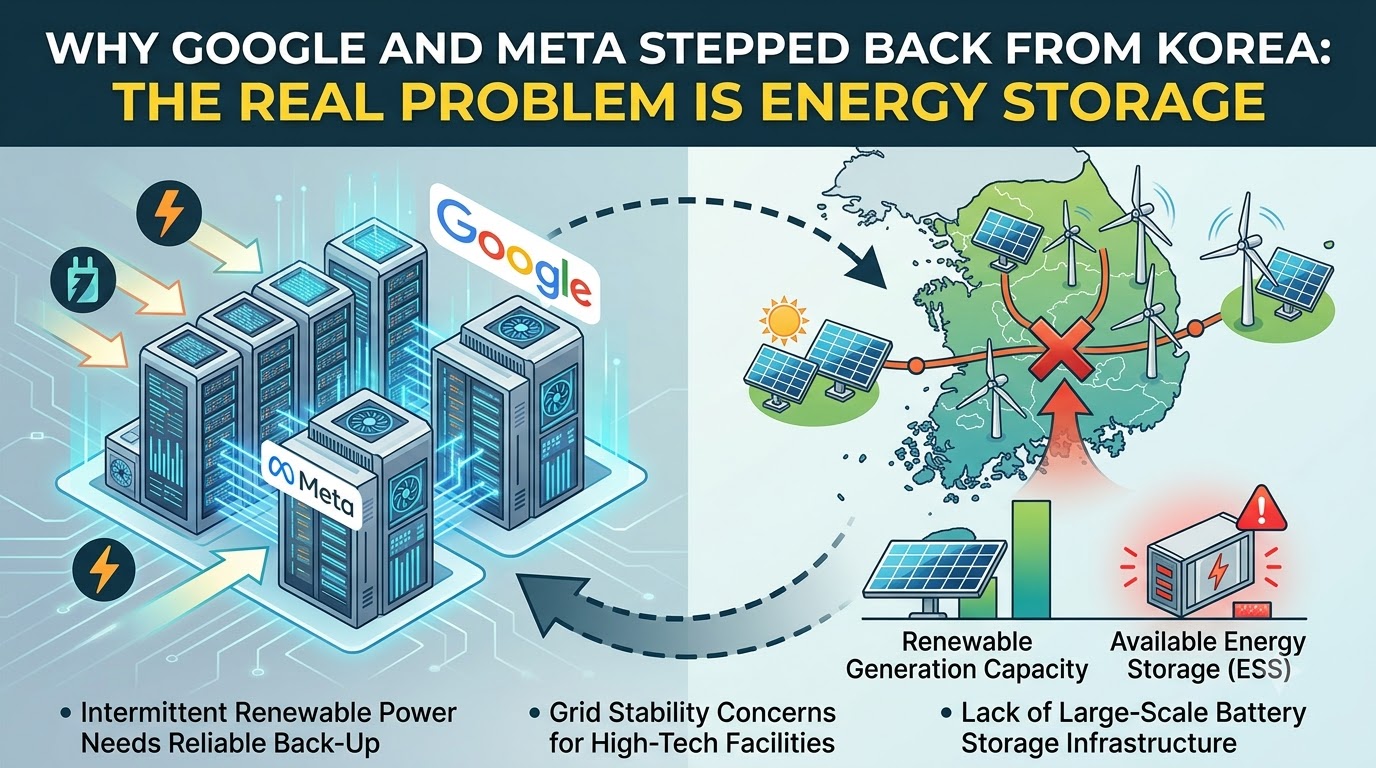
The Real Problem Is Energy Storage
The Data Center Dream Hit an Invisible Wall
Google and Meta were reportedly exploring Korea as a possible site for new AI data centers. On paper, that sounds like a huge opportunity. Korea has world-class digital infrastructure, strong tech talent and a strategic location in Asia. But the investment conversation stalled for one key reason: clean energy supply. More specifically, the real issue was not only generating renewable power, but storing it reliably enough for data centers that must run nonstop.
구글과 메타는 한국을 새로운 AI 데이터센터 후보지로 검토했던 것으로 전해졌습니다. 겉으로 보면 이는 엄청난 기회처럼 보입니다. 한국은 세계적인 디지털 인프라와 우수한 기술 인력, 그리고 아시아 내 전략적 위치를 갖추고 있기 때문입니다. 하지만 투자 논의는 결국 한 가지 핵심 문제 앞에서 멈췄습니다. 바로 청정에너지 공급입니다. 더 정확히 말하면, 재생에너지를 생산하는 것만이 아니라 24시간 끊김 없이 돌아가야 하는 데이터센터에 맞게 안정적으로 저장할 수 있는지가 진짜 문제였습니다.

Why Renewable Power Alone Is Not Enough
Big tech companies care deeply about ESG commitments, especially when building energy-hungry AI facilities. Solar and wind power are attractive because they reduce emissions, but they are also intermittent. When the sun is not shining or the wind is weak, the electricity has to come from somewhere else. That means storage is essential. Without enough energy storage, renewable energy cannot provide the stable backbone companies like Google and Meta need.
대형 기술 기업들은 특히 전력을 많이 소비하는 AI 시설을 지을 때 ESG 기준을 매우 중요하게 생각합니다. 태양광과 풍력은 탄소 배출을 줄이는 데 유리하지만, 동시에 날씨에 따라 출력이 달라지는 간헐적 에너지입니다. 해가 없거나 바람이 약할 때는 전기를 다른 방식으로 공급해야 합니다. 그래서 에너지 저장이 필수적입니다. 충분한 저장 능력이 없으면 재생에너지는 구글과 메타 같은 기업이 원하는 안정적인 기반 전력이 될 수 없습니다.
Korea’s Weakest Link Is Storage
According to the article, Korea’s renewable ecosystem still has a major gap in energy storage systems, or ESS. Investment in ESS weakened after stricter safety standards followed a 2017 fire, and business appeal fell further when additional incentives were removed. As a result, Korea can produce renewable electricity but cannot always keep or distribute it effectively. That creates a strange problem: sometimes power generation itself has to be cut to protect the grid.
기사에 따르면 한국의 재생에너지 생태계에서 가장 큰 약점은 에너지저장장치, 즉 ESS입니다. 2017년 화재 사고 이후 안전 기준이 강화되면서 ESS 투자가 위축되었고, 추가 인센티브가 사라지면서 사업 매력도도 더 떨어졌습니다. 그 결과 한국은 재생에너지를 생산할 수는 있어도, 그것을 효율적으로 저장하고 배분하는 능력이 충분하지 않은 상황에 놓이게 되었습니다. 그래서 전기가 남는데도 전력망 안정을 위해 오히려 발전을 줄여야 하는 이상한 문제가 생기고 있습니다.

Why That Scares Global Tech Firms
For ordinary facilities, occasional instability may be manageable. For AI data centers, it is unthinkable. These centers must operate 24 hours a day without interruption, and even a small risk of unstable power becomes a major investment red flag. That is why Korea’s storage problem is not a minor technical issue. It is a strategic weakness that can directly affect whether global tech firms choose to build here or go somewhere else.
일반 시설이라면 이런 불안정성을 어느 정도 감당할 수 있을지 모릅니다. 하지만 AI 데이터센터에는 그것이 상상하기 어려운 위험입니다. 이런 시설은 하루 24시간 중단 없이 돌아가야 하며, 아주 작은 전력 불안정 가능성조차도 투자 결정에서는 치명적인 경고 신호가 됩니다. 그렇기 때문에 한국의 저장 능력 부족은 단순한 기술 문제에 그치지 않습니다. 글로벌 테크 기업이 한국에 들어올지, 다른 곳으로 갈지를 좌우할 수 있는 전략적 약점이 되는 것입니다.
The Next Tech Race May Be About Batteries, Not Servers
President “Lee Jae Myung” has now publicly acknowledged the ESS problem, which is an important sign. But awareness alone is not enough. Korea’s next step is to treat storage not as a side issue, but as core national infrastructure. Like in “Frankenstein,” building something powerful without securing what sustains it can create instability rather than progress. If Korea wants to attract the next wave of AI investment, the real competition may begin not in chips or servers, but in batteries and grid resilience.
“이재명” 대통령이 이제 공개적으로 ESS 문제를 언급하기 시작했다는 점은 중요한 신호입니다. 하지만 문제를 인식하는 것만으로는 충분하지 않습니다. 한국은 이제 저장 인프라를 부차적인 요소가 아니라 핵심 국가 인프라로 다뤄야 합니다. “Frankenstein”처럼 강력한 무언가를 만들면서 그것을 지속시킬 기반을 확보하지 못하면, 진보가 아니라 불안정성이 생길 수 있습니다. 한국이 다음 AI 투자 물결을 유치하고 싶다면, 진짜 경쟁은 칩이나 서버가 아니라 배터리와 전력망 회복력에서 시작될지도 모릅니다.