
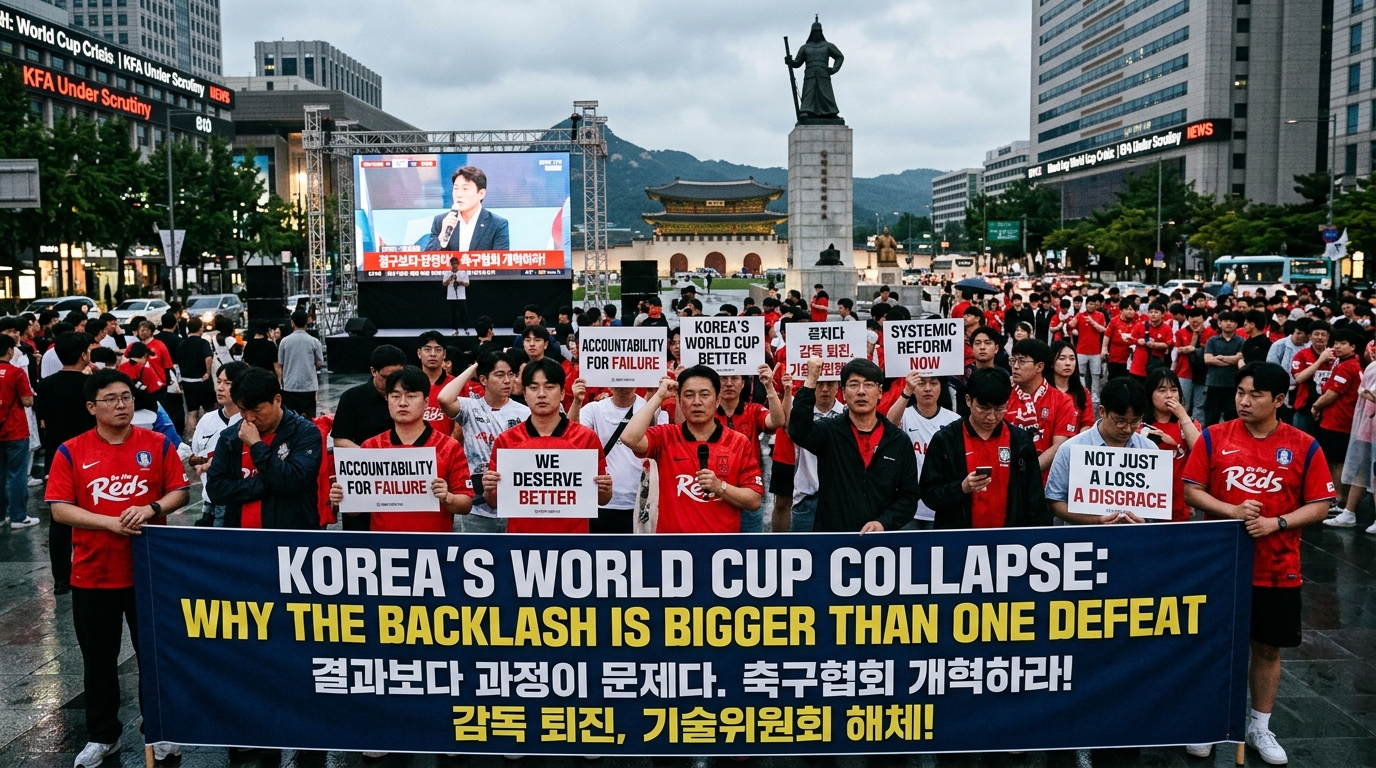
Why the Backlash Is Bigger Than One Defeat
More Than Elimination, It Felt Like a Breaking Point
Korea’s exit from the 2026 FIFA World Cup did not just disappoint fans. It triggered something much deeper — a sense that years of unresolved problems had finally exploded on the biggest stage. The team failed to reach the round of 32 despite what many called one of the easiest draws in modern Korean football history. For many people back home, this was not bad luck. It felt like a long-predicted collapse.
한국의 2026 FIFA 월드컵 탈락은 단순한 실망을 넘어서는 사건이었습니다. 오랫동안 누적되어 온 문제가 결국 가장 큰 무대에서 터져 나왔다는 느낌을 많은 사람들에게 남겼기 때문입니다. 대표팀은 한국 축구 현대사에서 가장 수월한 조 편성 중 하나라는 평가를 받았음에도 32강 진출에 실패했습니다. 많은 팬들에게 이것은 단순한 불운이 아니라, 오래전부터 예고된 붕괴처럼 느껴졌습니다.

Tactics Became the Immediate Target
Much of the anger focused on head coach “Hong Myung-bo” and his tactical choices. Former captain “Park Ji-sung” and commentator “Lee Young-pyo” both spoke publicly in unusually harsh terms, with Lee describing the South Africa match as the worst Korean football performance of the 21st century. What made the criticism sharper was the feeling that the team lacked structure, purpose and a clear match plan. Fans did not just see defeat. They saw confusion.
분노의 상당 부분은 “홍명보” 감독과 그의 전술 선택에 집중되었습니다. 전 국가대표 주장 “박지성”과 해설위원 “이영표” 모두 공개적으로 매우 강한 비판을 내놓았고, 이영표는 남아프리카공화국전이 21세기 한국 축구 최악의 경기였다고까지 평가했습니다. 비판이 더 날카로워진 이유는 팀에서 구조와 목적, 분명한 경기 운영 계획이 보이지 않았다는 인식 때문입니다. 팬들이 본 것은 단순한 패배가 아니라 혼란이었습니다.
The Viral “Fight” Clip Made Things Worse
Public frustration grew even more after a behind-the-scenes tactical clip spread online. In the video, “Hong Myung-bo” stands in front of a slide showing only one word: “FIGHT.” To many viewers, the message felt painfully empty at a moment when the team needed concrete ideas, not emotional slogans. The image of players sitting stiffly while the coach repeated the same word became symbolic of the broader complaint — too much spirit talk, not enough football substance.
대표팀 전술 회의 장면이 온라인에서 확산되면서 대중의 분노는 더욱 커졌습니다. 영상 속에서 “홍명보” 감독은 “FIGHT”라는 단어 하나가 적힌 슬라이드 앞에 서 있었습니다. 많은 시청자들에게 그 장면은 팀이 구체적인 전략보다 감정적인 구호에 의존하고 있다는 인상을 주었습니다. 선수들이 굳은 표정으로 앉아 있고 감독이 같은 말을 반복하는 모습은 더 큰 불만의 상징처럼 받아들여졌습니다. 정신력은 강조하지만, 정작 축구의 내용은 부족하다는 비판이었습니다.

The KFA Is Facing a Bigger Judgment
But the anger is not stopping with the coach. The Korea Football Association is now facing much broader scrutiny over years of alleged opacity, favoritism and weak accountability. Critics say this World Cup result reflects a deeper governance failure, not just a tactical one. Even President “Lee Jae Myung” publicly suggested that leadership and personnel decisions inside the KFA may have contributed directly to the collapse. In that sense, the defeat became a referendum on the system itself.
그러나 비판은 감독 개인에게서 끝나지 않고 있습니다. 대한축구협회는 수년간 이어져 온 불투명한 운영, 특정 대학과 지역 중심의 폐쇄성, 책임 부족 문제로 더 큰 심판대에 오르고 있습니다. 비판하는 사람들은 이번 월드컵 결과가 단순한 전술 실패가 아니라 더 깊은 조직 운영 실패를 반영한다고 보고 있습니다. “이재명” 대통령까지 공개적으로 협회 내부의 리더십과 인사 결정이 이번 붕괴에 직접적인 영향을 줬을 수 있다고 언급했습니다. 그런 의미에서 이번 탈락은 시스템 전체에 대한 국민적 평가처럼 받아들여지고 있습니다.
What Comes Next for Korean Football
The most painful part may be that this team was supposed to be one of Korea’s strongest in years. With players like Son Heung-min and Lee Kang-in, expectations were high. That is why the emotional fallout feels so intense. Like in “The Hollow Men,” the collapse was not loud and heroic, but empty and unsettling. Korean football now faces a simple but difficult question: will this humiliation finally force real reform, or will the same problems survive another tournament cycle?
가장 아픈 부분은 이번 대표팀이 오히려 최근 몇 년 중 가장 강한 전력을 갖췄다는 평가를 받았다는 점입니다. 손흥민과 이강인 같은 핵심 선수들이 있었기에 기대치도 높았습니다. 그래서 실망과 분노의 강도도 더 크게 느껴집니다. “The Hollow Men”처럼 이번 붕괴는 비장하고 영웅적인 몰락이 아니라, 공허하고 불안한 실패처럼 다가왔습니다. 이제 한국 축구는 하나의 단순하지만 어려운 질문 앞에 서 있습니다. 이번 굴욕이 정말 구조적 개혁으로 이어질 것인가, 아니면 같은 문제가 또 한 번 다음 대회까지 살아남을 것인가 하는 점입니다.