
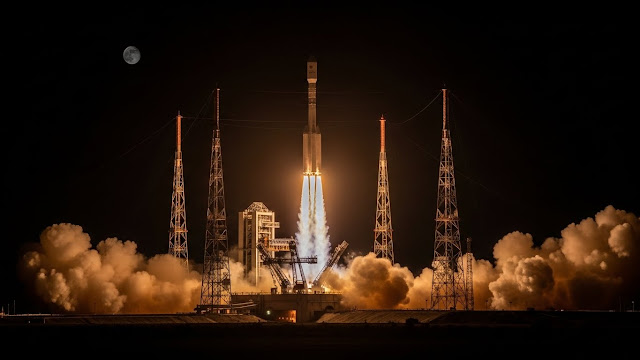
Nuri Rocket Successfully Deploys 13 Satellites
A New Dawn for Korean Space Technology
South Korea just made history! The homegrown Nuri rocket blasted off into the night sky from Naro Space Center, marking the country’s first-ever nighttime space launch. This isn’t just another rocket launch – it’s a giant leap forward for Korea’s space ambitions and private sector involvement.
한국이 역사적인 순간을 만들어냈습니다! 국산 누리호 로켓이 나로우주센터에서 밤하늘로 발사되며 한국 최초의 야간 우주 발사를 기록했습니다. 이것은 단순한 로켓 발사가 아니라 한국의 우주 개발 목표와 민간 부문 참여를 위한 거대한 도약입니다.
Overcoming Challenges to Reach the Stars
The launch wasn’t without its drama. Originally scheduled for 12:55 a.m., technical issues with a pressure sensor delayed liftoff until 1:13 a.m. But once it launched, the Nuri rocket (also known as KSLV-II) performed flawlessly, carrying 13 satellites including the main payload “CAS500-3” – a sophisticated 500-kilogram satellite designed for cutting-edge science missions.
발사에는 긴장감이 넘쳤습니다. 원래 오전 12시 55분으로 예정되었던 발사는 압력 센서의 기술적 문제로 오전 1시 13분으로 지연되었습니다. 하지만 일단 발사되자 누리호는 완벽하게 작동했고, 첨단 과학 임무를 위해 설계된 정교한 500kg 위성인 “CAS500-3″를 포함한 13개의 위성을 탑재했습니다.
.png "Nuri rocket")
Private Sector Takes the Lead
What makes this launch truly groundbreaking? For the first time, Hanwha Aerospace led the entire operation instead of the Korea Aerospace Research Institute. This transfer of responsibility represents Korea’s commitment to building a robust commercial space industry. Hanwha will continue managing the next two launches scheduled for 2026 and 2027.
이번 발사를 정말 획기적으로 만드는 것은 무엇일까요? 한국항공우주연구원 대신 한화에어로스페이스가 처음으로 전체 작업을 주도했다는 점입니다. 이러한 책임 이전은 강력한 상업 우주 산업을 구축하려는 한국의 의지를 나타냅니다. 한화는 2026년과 2027년에 예정된 다음 두 번의 발사도 계속 관리할 예정입니다.
Perfect Execution in Orbit
The mission unfolded like clockwork. The rocket successfully separated its first and second stage engines within five minutes, reached 500-kilometer altitude after seven minutes, and deployed all 13 satellites into their 600-km orbit. Each cube satellite was released with precise 20-second intervals, demonstrating Korea’s advanced space technology capabilities.
임무는 시계처럼 정확하게 진행되었습니다. 로켓은 5분 이내에 1단과 2단 엔진을 성공적으로 분리했고, 7분 후 500km 고도에 도달했으며, 13개의 위성을 모두 600km 궤도에 배치했습니다. 각 큐브 위성은 정확히 20초 간격으로 방출되어 한국의 첨단 우주 기술 역량을 보여주었습니다.
.png "Nuri rocket")
Looking Toward a Brighter Future
KASA Administrator “Yoon Young-bin” emphasized that the Nuri rocket will conduct two more flights through 2027 to enhance technological stability. But Korea isn’t stopping there – plans are already underway to develop next-generation launch vehicles that will be even more advanced than Nuri.
한국항공우주청장 “윤영빈”은 누리호가 2027년까지 두 차례 더 비행을 수행하여 기술적 안정성을 강화할 것이라고 강조했습니다. 하지만 한국은 여기서 멈추지 않습니다. 누리호보다 더욱 발전된 차세대 발사체 개발 계획이 이미 진행 중입니다.
Deputy Prime Minister “Bae Kyung-hoon” declared Korea’s ambitious goal: becoming one of the world’s top 5 space powerhouses capable of moon and deep space exploration.
“배경훈” 부총리는 한국의 야심찬 목표를 선언했습니다. 달과 심우주 탐사가 가능한 세계 5대 우주 강국이 되는 것입니다.